19 Dec 2025
New Pulseq CEST Library paper
The Pulseq CEST Library now includes data evaluation!
We share some simplified evaluation codes in Matlab and Python on Pulseq-CEST now. We invite everybody to use and contribute to this codebase.
The library now includes sequences, simulation files, and evaluation codes, allowing you to simulate the full chain including debugging and testing: Find specific codes here; https://github.com/kherz/pulseq-cest-library/tree/master/eval-examples
And the paper describing how this is helpful here:
“The Pulseq-CEST Library: definition of preparations and simulations, example data, and example evaluations”
Pulseq-CEST files can be played out at a Siemens system directly with the Pulseq CEST hybrid sequence available upon request on C2P, or by combining any Pulseq-CEST preparation with any Pulseq sequence as described here.
If you do it right, you can now even have online recon with Pulseq on a Siemens Scanner, so prototyping new approaches, both preparation and readout, including deployment for feasibility studies or early clinical studies have never been easier.
Also solutions for pTx-Pulseq exist.

05 Jul 2023
Bloch-McConnell simulation challenge
The Bloch-McConnell simulation (BMsim) challenge compared and improved simulations codes of many international groups.
It validates the intrinsic Pulseq-CEST simulations and everybody can now validate their CEST simulation!
More infos here: https://github.com/pulseq-cest/BMsim_challenge

11 May 2023
We’re delighted to invite you to our Pulseq-CEST Webinar focused on the Pulseq-CEST tool and its role in simplifying prototyping, simulation, and reproducibility in CEST MRI research.
Pulseq-CEST Webinar
This took place on Thursday, July 6, 2023
Here is the recording on Youtube:
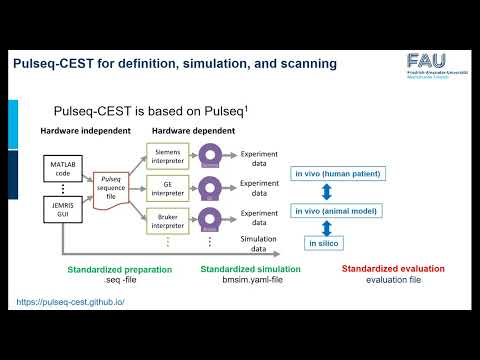
In this webinar, you’ll discover:
- How the Pulseq-CEST tool streamlines CEST MRI research in silico, in vitro and in vivo
- Live demonstrations of the tool using MATLAB and Python https://pulseq-cest.github.io/
- The existing library of preparation modules and simulation files https://github.com/kherz/pulseq-cest-library
- Ways to contribute and collaborate within the Pulseq-CEST community.
For any questions, feel free to contact us.
Here more links:
- https://pulseq-cest.github.io/
- https://github.com/kherz/pulseq-cest
- https://github.com/schuenke/BMCTool
with colabs
- https://colab.research.google.com/drive/1lFAxOR_I_J4x5pn_preEUPG9ZfNiPIVw#scrollTo=utnYU7mvEYxj
- https://colab.research.google.com/drive/1LOxexCtYDihmIQtrBkZq_Qj19HR1ij5P#scrollTo=bKx81ocDoyzj
- https://github.com/KerstinHut/pypulseq-cest
- https://github.com/kherz/pulseq-cest-library
- https://github.com/pulseq-cest/BMsim_challenge
- https://gitlab.com/SebMue/pulseq_cest_hybrid_bruker
23 Dec 2021
The recording of the Pulseq-CEST talk from the MRI Together workshop is now available on YouTube:
06 Dec 2021
There is a new Pulseq-CEST MATLAB version available, with additional functionality and speed improvements.
21 Oct 2021
The Pulseq-CEST project will be covered in an educational talk at the MRI together workshop.
07 May 2021
The Pulseq-CEST Paper is now published in MRM, you can find it here.
The code used in this publication can be found on GitHub with the mrm-paper tag.
04 May 2021
The Pulseq-CEST project will be presented at ISMRM 21 during the CEST Digital Poster session.
- When: 17th May 17:00 - 18:00 UTC
- Abstract Number: 1465
- Abstract link
13 Jan 2021
Welcome to the new Pulseq-CEST project page!
We will inform you about updates here, while all the project description and instructions can be found on GitHub.
If you want to contribute to the project or have any questions, please feel free to contact us!